
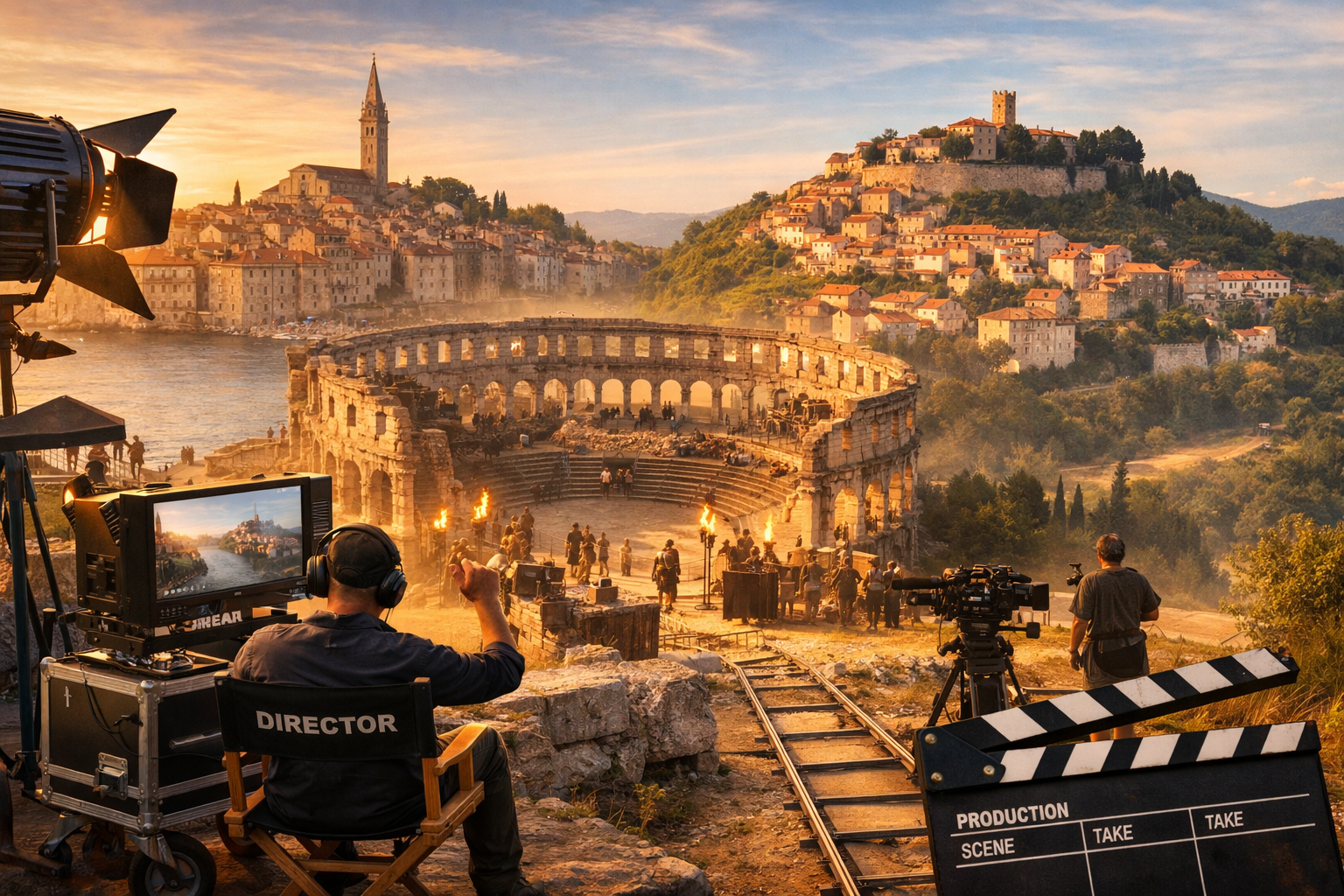
There is a moment just before sunrise in Istria when the light turns soft and cinematic. The sea is still. The stone towns glow. The landscape feels like a ready-made film set — because in many ways, it is.
Recently, I completed professional training with the Istrian Cultural Agency (IKA–ACI), deepening my understanding of the region’s film infrastructure, production logistics, and creative potential. The program opened a broader perspective on how Istria’s layered history and striking natural diversity make it uniquely adaptable for cinema — from ancient Rome to Venetian republics, from Austro-Hungarian elegance to modern Mediterranean minimalism.
Through this education, I expanded my knowledge of location scouting possibilities, permitting frameworks, cross-border production support, and the strategic role of cultural institutions in audiovisual development. Istria is not only beautiful — it is operationally ready.
And filmmakers have known this for decades.
The Roman amphitheatre in Pula has hosted epic scenes. The hilltop silhouette of Motovun has framed historical dramas. Coastal towns, abandoned fortresses, olive groves, forests, and minimalist modern villas have all appeared on screen. International productions, European co-productions, independent films, commercials, and streaming projects continue to use Istria as a versatile cinematic backdrop.
What makes this peninsula exceptional is density of contrast within short distances. In less than an hour, you can move from Roman ruins to Venetian Gothic streets, from medieval hilltop villages to wild cliffs, from fertile inland valleys to open Adriatic horizons. Few regions in Europe offer this range without heavy set construction.
But beyond aesthetics, there is knowledge.
Understanding how film and territory interact — how heritage sites can be protected while becoming active stages — requires coordination between cultural agencies, local governance, and creative professionals. The IKA–ACI framework emphasizes exactly that: structured support, cultural sensitivity, and sustainable audiovisual growth.
For me, this training was not simply about film. It was about interpretation.
As a guide, I already tell stories rooted in archaeology, architecture, memory, and landscape. Now I can also speak about Istria as a production territory — a place where history is not only preserved, but performed.
Istria is not just a destination.
It is a living scenography.
And when you walk through its streets, you may not just be visiting a region — you may be stepping onto a set where centuries are always ready for the next scene.